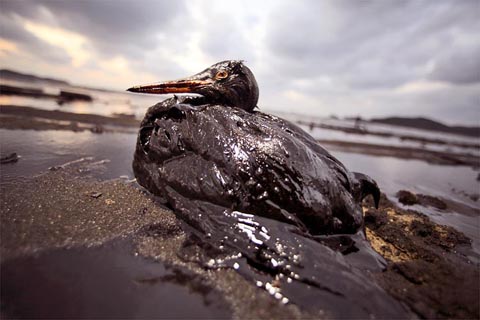
Showing posts with label oil spill. Show all posts

Sunday, August 1, 2010

Harsher Restrictions for Drilling

Several days ago the House approved a bill that will force safer regulations on offshore drilling. In addition, this bill will also enforce new fees on oil and gas production and remove a federal cap on economic liability for oil spills. This bill is in response to the disastrous Gulf oil spill that happened back in April.

Naturally there was disagreement over this bill between Republicans and Democrats. What this Bill will do is ban companies with serious environmental or workplace violations in the past seven years from being granted new permits for offshore drilling. The issue found by many Republicans and even some Democrats with high interest in oil fear that these regulations will hurt the U.S. economy. They believe it will take away countless U.S. jobs and raise energy prices.

This issue has not yet reached the Senate. According to a New York Times article the bill would:

- remove the $75 million cap on economic damages to be paid after big oil spills,

- increase the financial responsibility demonstrated by offshore operators to 300 million dollars,

- and finally create “conservation” fees on oil and natural gas that has been extracted from federally owned land or water

This was particularly disturbing to Rep. Doc Hastings, the ranking Republican on the House Natural Resources Committee. He believes that the removal of the liability cap could be extremely detrimental to small and medium-sized drillers.

With this said I actually think this bill is a great step in the right direction. With the number of oil spills occurring offshore lately there had to be steps taken to try and ensure that such spills cease to happen. The environment is so destroyed each time there is a spill, not to mention we lose more and more of our oil. Big companies should be held responsible for their actions in these spills. And while I don’t want to see smaller drilling companies hit, we really need to have the safety of our environment and the preservation of our resources as a number one concern.

Tuesday, July 27, 2010

Louisiana Just Can’t Catch A Break

Just when you thought things were starting to look up in terms of the oil spill in the South another disaster strikes. That may sound a little dramatic as we don’t yet know the reach of this spill, but it’s really not too far off the mark. It is highly unlikely that this spill will ever reach the catastrophic proportions that the April 20th Deepwater Horizon spill reached, and a Jefferson Parish Councilman has already said he believes that the spill can be stopped today. However, the fact that there is another spill so soon after that one and so close to the origin of that spill is disturbing.

It was reported by the AP that a tugboat ran into a wellhead in a bay by Mud Lake. Oil is now being emitted into the water and is visible above the surface. This occurred to the north of a bay where officials have been working steadily to contain the spilling oil from the BP tragedy.

This area has been described as “ecologically sensitive” and although no one is sure yet how much oil is being ejected into the water, there are reports of a visible sheen in the lake.

Oil is such a crucial resource to the United States and we have lost so much of this resource within our own borders. We already didn’t like being so dependent on foreign oil, and it seems like these constant spills keep pushing us back to the oil in the Middle East.

The way I see it one of two things needs to happen here. Either we need to have more competent rig workers and boat captains and there needs to be a higher emphasis placed on personal responsibility, or we can’t keep drilling deep-sea oil wells. If we aren’t capable of drilling out in the water without causing environmentally detrimental spills then we can’t keep drilling there.

We really need more stringent regulations on our oilrigs and more constant monitoring that these safety regulations are enforced. People keep saying that it was under President Bush that regulations were slackened. But the way I see it is that he has been out of office for a year and a half and perhaps Obama should have paid closer attention to these issues. After all it has been under Obama that the worst spill in history occurred. But now is the time for increased monitoring to make sure another spill doesn’t occur. It’s too late to go back and prevent the ones that have been, now it’s time to look to the future and the preservation of our environment.

Wednesday, July 21, 2010

Dead Penguins v. Gulf Spill: What Can We Do?

Today I was reading through online news sites and I came across a story about dead penguins washing up on the shore of Brazil. This got my mind turning towards the death and destruction of wildlife in the Gulf region of the United States. Now I consider myself a friend to the animals (I don’t wear fur or condone animal testing – but I do eat meat) and I always seem to find myself drawn to stories about nature and animals in need. The main idea of the article is that scientists believe it is most likely overfishing that is leading to the death of the penguins. The fish and squid they feed on are becoming scarce.

My concerns here are two-fold. If it is indeed overfishing that is killing these flightless birds, then what is going to happen to the remaining wildlife in the Gulf, those animals that have not been killed by the spill? This region was already heavily relied upon as a source of great quantities of seafood for the United States and the rest of the world. What is to happen now when there isn’t enough seafood to go around, when people can no longer make their living in the trade they knew and worked so hard to build? If certain areas are deemed safe for fishing but others are not, then wont there be a situation of not enough food here for the wildlife? What is going to happen now if fish are affected by the spill and are deemed unsafe for human consumption? Further, what is going to happen to the other animals whose main source of nourishment are these fish that have been affected?

I was doing some reading on the estimated death tolls for wildlife in the Gulf region since the spill and found the numbers to be nauseating. The Fish and Wildlife Service webpage has created a list of all the dead wildlife found in the five Gulf States (Alabama, Florida, Louisiana, Mississippi, and Texas) as well as those collected on the water since the spill. The website has listed 62 dead mammals, which includes dolphins, 478 dead sea turtles and 2,333 collected dead birds since the spill occurred three months ago.

These numbers disturbed me beyond belief. I had known that the devastation was widespread but these numbers truly appear staggering when listed together. This leads into my second concern about the news story on the dead penguins washing ashore. If it is over fishing that is causing the death of these penguins than is there something that can be done to fish in different areas and leave more fish for the animals to consume? Or, since the oceans belong to everybody in the world, is this now not even a possibility due to the serious blow that the Gulf of Mexico has suffered?

Something else that concerns me is the lack of focus that people seem to be able to devote to one serious issue at a time. While I am thoroughly upset by the dead penguins I still think that the focus right now should be the oil crisis. I understand that the United States is not the center of the world and that’s why Americans get a bad rep from the rest of the world, but this is being called the worst spill in history and this disaster will affect people everywhere. This deserves widespread attention.

Not only are there endless stories about what is happening to the fishing industry, but I often read articles about the oil that has washed up on the beaches in the Gulf States and how this effecting the morale of those who live there. Yet we can’t “otherise” this spill. It is effecting everyone and I do think that focus needs to be spent figuring out how to appropriately clean the area. Serious attention also needs to be placed on ensuring that a spill like this never occurs again because humans have caused this terrible disaster to the environment and we need to learn that we have limited resources here, we can’t allow for such quick destruction of what little we have to work with.

Thursday, July 15, 2010

Seafood from the Gulf

Summer is usually the time for sunshine filled trips to the beach and out-door cookouts, but this year there is a dark cloud hovering over the summer holiday. Unless you have been living under a rock for the past two and half months you should at least be familiar with the BP oil spill that began back in late April. Even now in mid-July oil continues to gush into the waters off the Gulf Coast making this spill one of the most devastating in history.

And while almost everyone has heard of the spill, not everyone fully comprehends the gargantuan effect that this disaster is having on the ecosystem in the South. It is not just the wildlife that is suffering from this catastrophe. All those whose livelihood is dependent in some way or another on the seafood industry are in jeopardy of losing their source of revenue.

The latest news as reported by The New York Times is that the waterways connected to the Gulf, specifically Lake Pontchartrain, are now in danger of becoming engulfed in oil. This would be particularly devastating to the seafood industry as it is such a rich supplier for the country. Naturally, people don’t want to eat anything that could be contaminated or dangerous. While regulations have been placed to halt fishing in areas known to be contaminated, and testing of fish is more extensive than ever before, people still have reservations about gulf seafood. And why shouldn’t they when the news is dominated by how dangerous and extensive the spill is?

There has already been one major casualty of the oil spill in the seafood industry of the South. P&J Oyster Company, the nations oldest oyster shucking company, which has been a Louisiana staple for over 130 years, has closed its doors. Oysters take a long time to mature to market size and since they are being so affected by the spill, and efforts to clean it, this company will remain closed for quite some time to come.

This may not be the forefront issue being discussed regarding the oil spill but it certainly is an important one, and one worth addressing. What would happen if the water becomes so polluted that all the wildlife die out and the ecosystem becomes so decayed that the damage cannot be reversed? What if even more seafood businesses in the South must be shut down, resulting in reverberations felt throughout the rest of the country? This has been a concern of many living along the eastern seaboard.

In an already downturned economy, can we afford for there to be another major industry virtually wiped out? This could be what is to come of fisherman and seafood restaurants in the South if this oil spill is not contained, and even if it is, is the damage that has been done reversible? How can confidence be restored in Gulf seafood when effects of the spill are still not completely known? I fear this is just further evidence of how ill prepared we are as a country to deal with the disasters that occur around us.